The Importance of Data Classification and Discovery
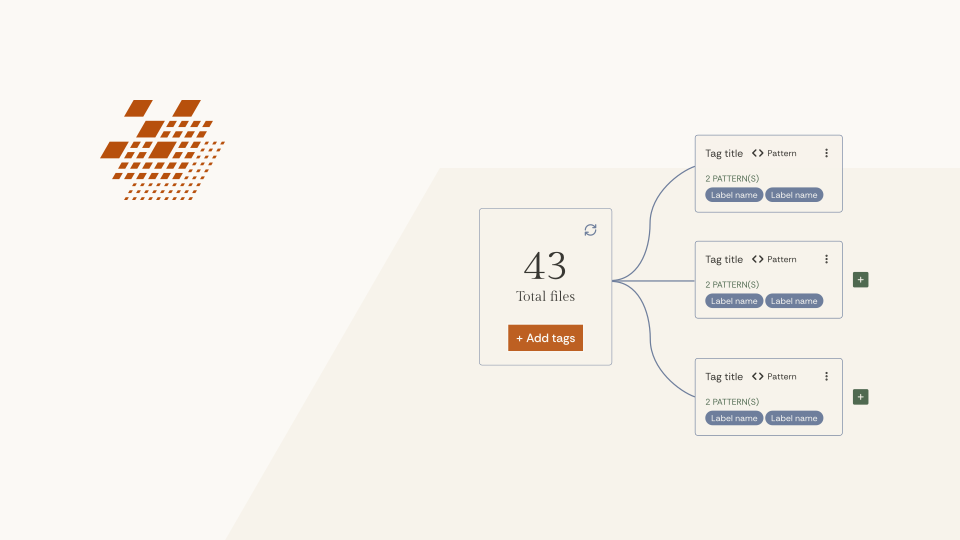
Understanding Data Classification and Discovery
Definition and Overview
Data classification and discovery are critical processes in managing and securing enterprise data in today’s digital world.
Key Differences and Interdependencies
While data classification and discovery are distinct processes, they are highly interdependent. Classification is crucial for organizing data into meaningful categories, which then facilitates more efficient discovery. Conversely, effective data discovery techniques can unearth insights that help refine data classification criteria and processes, enhancing the overall
Importance in the Current Data-driven Landscape
In the current scenario, where data volumes are exploding exponentially, the role of data classification and discovery becomes more significant than ever. These processes not only help organizations manage this vast amount of data but also ensure that sensitive information is adequately protected, yet accessible. Efficient data classification and discovery enable businesses to leverage their data effectively, aligning insights with organizational goals and driving business growth.
The Role of Data Classification in Regulatory Compliance
Overview of Data-related Regulations (GDPR, HIPAA, etc.)
Various global and regional regulations such as the
How Data Classification Helps in Compliance Execution
Data classification streamlines compliance by delineating which data sets are sensitive and therefore subject to stringent controls. For example, identifying and classifying personal health information or financial data under respective regulatory laws can guide the deployment of enhanced security measures, such as encryption and restricted access, ensuring legal compliances are met with reduced risk of data breaches.
Case Studies: Real-world Compliance Scenarios
Consider a healthcare provider that implemented a data classification system to better manage patient records in compliance with HIPAA. By classifying data at the point of creation and throughout its lifecycle, the provider ensured that sensitive health data received the highest level of security protocols, significantly mitigating potential compliance issues and establishing a robust defense against data theft or leakage.These sections have built the foundation of understanding around how pivotal data classification and discovery are in the context of a data-driven enterprise ecosystem. Moreover, contextualizing these processes within the framework of regulatory compliance underscores their relevance and utility in today's highly regulated industries. Please ensure each term from the list that appears in the text of these sections is hyperlinked correctly and update the H2 headings as required. Return the revised text without any additional commentary.
Data Discovery Techniques and Tools
Techniques for Effective Data Discovery
Data discovery is a critical process that organizations use to categorize and locate data within their vast repositories. It is crucial for enterprises to adopt effective techniques to streamline this process, ensuring that data is not only discoverable but also accessible and usable. A successful data discovery strategy often employs a mix of manual and automated methods. Metadata tagging is a significant technique where data items are tagged with
Overview of Leading Data Discovery Tools
With the advancement of technology, several tools have been developed to assist enterprises in the data discovery process. Tools like
Integrating Tools into the Existing Data Stack
Integration of these tools into an existing data stack should be done with precision and planning. It primarily involves ensuring compatibility with the current data management systems and training the workforce to utilize these tools effectively. An essential aspect of integration is data silo prevention and ensuring a single source of truth across all data platforms. Workflow automation can be particularly useful here, where data discovery tools are configured to automate parts of the discovery process, such as data indexing and classification, thus reducing manual oversight and potential errors.
Enhancing Data Security through Rigorous Data Classification
Identifying Sensitive Data
Identifying what constitutes sensitive data is the first crucial step in data classification. Sensitive data can range from personally identifiable information (PII), protected health information (
Protecting Data through Access Controls and Encryption
Once sensitive data is identified, protecting it becomes paramount. Implementing strict access controls ensures that only authorized personnel have access to sensitive data, thereby reducing the risk of data breaches. Access controls should be both role-based and context-aware to address various access scenarios and compliance requirements. Furthermore, encryption serves as a last line of defense for protecting data at rest, in transit, and in use, ensuring that even in the event of unauthorized access, the data remains unreadable and secure.
The Role of AI and Machine Learning in Data Security
The Impact of Efficient Data Discovery on Business Intelligence
Improved Data Access and Usability
In today's digital era, efficient data discovery is paramount for enhancing the accessibility and usability of data across various business departments. When data is easily accessible and user-friendly, organizations can optimize their operational efficiency and accelerate decision-making processes. Data discovery tools play a critical role in indexing vast data repositories, making it easier for users to retrieve relevant information swiftly. This immediacy not only boosts productivity but also fosters a [data-driven](https://www.sydle.com/blog/data-driven-what-it-is-and-why-it-s-important-606c8a4e4b136c41e0e2c334) culture by empowering more employees to rely on data insights for daily tasks and strategic initiatives.
Leveraging Discovered Data for Strategic Decisions
The strategic leveraging of discovered data can transform standard business operations into insightful, outcome-oriented procedures. By analyzing patterns and trends within the discovered data, businesses can gain actionable insights that drive strategic decision-making. This scenario is particularly evident in areas like market analysis, customer behavior predictions, and operational optimizations. For instance, a retail company could use discovered data to tailor marketing strategies, predict seasonal sales trends, and optimize supply chain logistics, thereby gaining a competitive edge in the marketplace.
Case Example: Business Intelligence Transformation through Data Discovery
Consider the case of a multinational healthcare provider that implemented advanced data discovery solutions to enhance its business intelligence efforts. By integrating a robust data discovery platform, the organization could streamline data access, making it easier for analysts and stakeholders to extract and interpret critical data. This transformation led to improved patient care strategies, optimized resource allocation, and a better understanding of market needs and trends. As a result, the healthcare provider not only improved its service delivery but also achieved significant cost savings and an enhanced competitive position in the industry.
Data Classification and Discovery in Handling Unstructured Data
Challenges Posed by Unstructured Data
[Unstructured Data](https://www.mongodb.com/unstructured-data), which includes emails, videos, social media posts, and more, poses significant challenges due to its size and non-uniform nature. Traditional data management tools are often insufficient for effectively indexing and analyzing such data, resulting in potential insights being left untapped. The lack of structure makes it difficult to categorize and retrieve relevant information efficiently, thereby compounding the risks of data breaches due to inadequate [data protection](https://www.snia.org/education/what-is-data-protection) measures.
Techniques for Classifying and Discovering Unstructured Data
To address the idiosyncrasies of [Unstructured Data](https://www.mongodb.com/unstructured-data), businesses are increasingly turning to advanced techniques like [Natural Language Processing](https://aws.amazon.com/what-is/nlp/) (NLP), image recognition, and machine learning algorithms. These technologies allow for the automatic classification of unstructured data by identifying patterns, themes, and relationships that would be impossible to discern manually. Such classification not only enhances data security by identifying sensitive information but also improves usability by tagging content for easy retrieval.
Benefits to Organizational Knowledge Management
Effective classification and discovery of unstructured data can lead to substantial improvements in knowledge management. When unstructured data is properly indexed and accessible, it increases the collective knowledge base of an organization, enabling better decision-making and innovation. For example, in the case of a legal firm, efficiently classified case files and legal precedents can aid in quicker case resolution and strategy formulation. Similarly, in research-oriented industries, quick access to accumulated knowledge expedites innovation cycles and promotes a more collaborative environment. By addressing these aspects diligently, enterprises can greatly enhance their data management practices, leading to significant improvements in operational efficiency, strategic decision-making, and competitive advantage.
Automating Data Classification and Discovery with AI and ML
How AI/ML are Changing the Landscape
The integration of
AI-driven Automation Examples and Case Studies
Many organizations across various industries are already experiencing the benefits of AI-driven automation in data management. For instance, in the healthcare sector, ML models are being used to classify different types of clinical data into
Predictions for Future Developments in AI/ML for Data Classification and Discovery
The future of AI and ML in data classification and discovery looks promising, with continuous advancements expected in the coming years. Predictive analytics is one area where AI is set to make significant impacts, allowing companies to forecast trends and patterns effectively, thereby facilitating proactive decision-making. Furthermore, as
Best Practices for Implementing Data Classification and Discovery Strategies
Step-by-Step Implementation Guide
A successful implementation of data classification and discovery strategies begins with a thorough assessment of the existing
Common Pitfalls and How to Avoid Them
One common pitfall in implementing data classification and discovery strategies is underestimating the complexity and scale of the organization’s data. To avoid this, it's critical to involve all stakeholders from the early stages and ensure thorough training and understanding of the tools and policies in place. Furthermore, failing to update systems and policies regularly can lead to inefficiencies and vulnerabilities. Establishing a regular review and update process is essential to adapt to new challenges and changes in regulatory requirements.
Continuing Education and Training for Teams
As AI and ML technologies evolve, so does the necessity for ongoing education and training for teams responsible for data management. Organizations should prioritize regular training sessions and workshops to keep the team updated on the latest technologies, policies, and best practices. Encouraging certifications in data management and security can also promote a higher standard of knowledge and practice within the team. By fostering a culture of continuous learning, companies can better equip their employees to manage the complex landscape of data classification and discovery effectively.
Discover the Future of Data Governance with Deasie
Elevate your team's data governance capabilities with